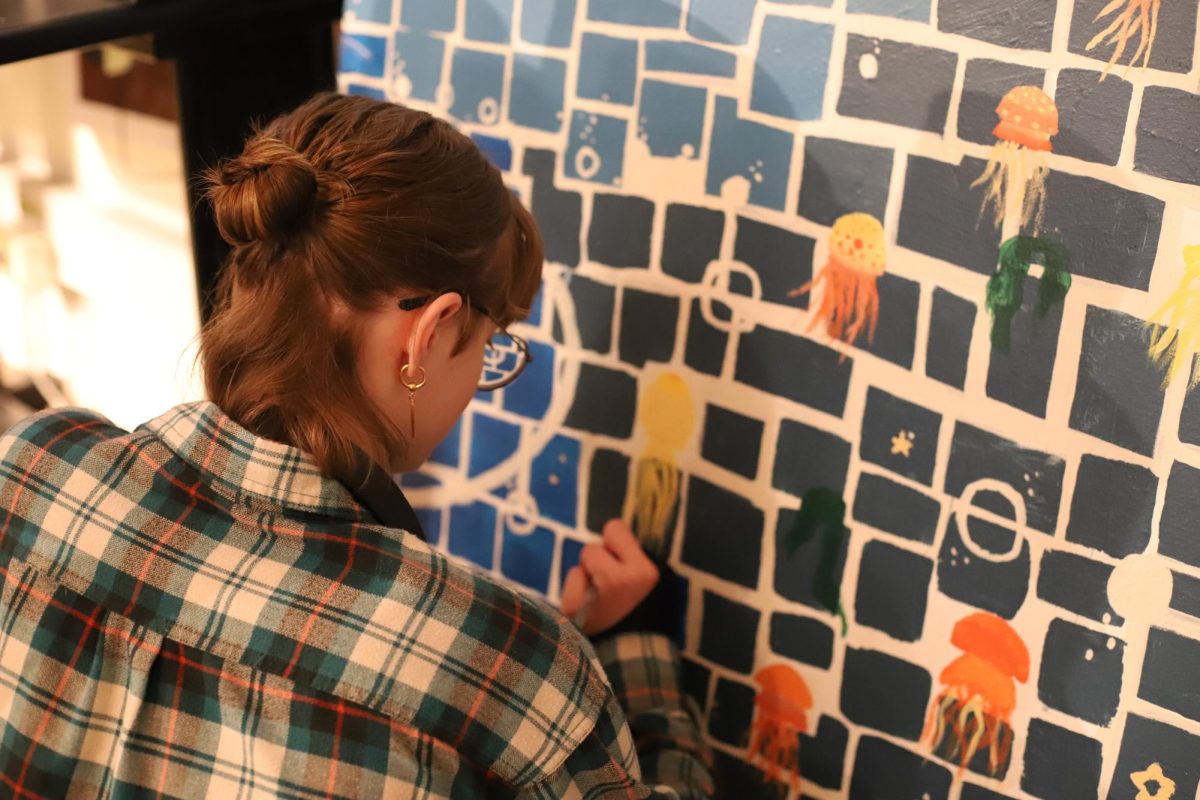
![Senior Evelyn Bly draws in the art therapy lab on Tuesday, January 20th. Students joined the lab to process their internal emotions through physical art. They then shared their pieces with each other at the end of the lab. “[AI] takes away from the creativity of being inherently human,” junior Annika Pulkrabek said.](https://chstoday.net/wp-content/uploads/2026/01/IMG_9948-2-1200x800.jpg)
AI has become a big part of society today, it’s included in the students and staff members in classrooms and lives.
AI—Artificial Intelligence—has become an important student resource in today’s classroom setting, with students using it to help them through homework assignments, enhance their creative work, or write challenging writing responses. Some find these AI sources beneficial, seeing little impact these bots have, though others find that they hurt creativity and bring about an educational roadblock.
Artificial Intelligence can help solve challenging mathematical equations and write essays. For some, this is seen negatively; for others, it’s informative and helpful, with many on the fence given its use.
“All the information in the world at your fingertips, most of it relatively accurate. Some cons are that you could sneak through a lot of things and never learn anything. Like you and I in physics class could probably do quite well with AI,” human geography teacher Benjamin Anderson said.
Chatbots like ChatGPT, Google Gemini, and Claude can condense timely projects into quick assignments, occupying less time and providing more efficient studies.
“I use [AI] in English to help me with reading books and to understand what we’re reading about, and I also use it in biology to get a reliable source,” freshman Elliana Marchiondo said.
In the English field, writing essays or other long-form pieces can become overwhelming for some students; however, English and AP Literature teacher Joshua Nielson finds that AI has a detrimental effect on writing skills and test-taking.
“A lot of the time, students have no idea that they are bypassing their critical thinking because they’re so used to using AI for almost everything,” Nielson said.

Nielson emphasized the frequent use of AI in students’ lives, using it as a tool in different ways, sometimes for an “easy way out” of assignments.
“[The students] had to do this big study guide, and it is really hard to ask them to look up a ton of stuff, right?” Nielson said. “Well, all they were doing at the beginning was [wanting] to type the questions into AI and copy it down. I just said to them, ‘You guys, this is not going to help you do well on the test where you don’t have AI.’”
Although Nielson has observed negative effects in the classroom, he has also found use for it in a teacher’s position.
“AI helped us teachers to research and learn about texts that we didn’t know about. Because I’m just one person, I can’t know everything,” Nielson said. “And even if I go to the library and spend a lot of time trying to find texts over the course of my career, the idea that it could give me a really good text that helps me make a good curriculum [quickly] is pretty good right?”
Not only is AI used in core classes, it is also used in electives like theatrical, musical, and physical art where artistic ability can shine.
“Usually the script is going to tell us what to do with stage directions, so with AI you can put in a prompt saying, ‘we have a high school stage of blank, with blank length, what do we need to have minimum transition scenes to make everything flow?” theater teacher Aaron Middleton said.
There are also impacts on the art classroom because of AI. It can be used for formulating ideas in addition to entire art pieces, which art students have expressed their discontent with.
“I don’t use AI for my art class, I feel like that kind of takes away from the purpose of the class, which is human creativity, not generative AI because I feel like that’s not creative,” junior AP art student Chloe Plow said.
Outside generating images and completing work, AI can also brainstorm ideas for art projects or English assignments.
“I think [AI] would be better if it went with ideas instead of creating art. I think it’s good for coming up with ideas, but not actually creating art,” junior AP art student Annika Pulkrabek said.