
As track and field kicks off, runners are excited to get the season rolling. Some athletes run short distances, such as 100 and 200m, while others run longer distances, such as 1600m and 3200m, each coming with its own set of unique challenges and roadblocks.
For many kids on the team, the appeal of track runs beyond their time. It’s about the improvement and the rewarding feeling that comes with every lap.
“It’s really fun,” sophomore Collin Sullivan said. “Running makes me feel good.”
The satisfying feeling that Sullivan gets from running is a common theme surrounding long-distance runners. He doesn’t shy away from even the most challenging and mentally taxing competitions in all of track.
“I run the 3200 meter,” Sullivan said. “It’s hard but rewarding.”
While the stress of race day is real, it’s the social factor of track that keeps most kids coming back season after season. For sophomore runner Nevyn Boymel, the competitions come with a few benefits.
“The meets are fun, I love hanging out with friends,” Boymel said.
Throughout the track season, the team’s elevated environment provides a unique advantage for its runners. Training at nearly 8,300 feet, runners have to endure the thin air, making the first couple of weeks of practice a nightmare. However, the endurance it forces gives the team a sizable advantage when they travel to lower elevations for meets.
In addition to short-distance and long-distance runs, the sport also includes the long jump and triple jump.
”For the triple jump, you have three phases. You have your first phase, which is your pop-up. Then you have your second phase, which is more of a lunge forward, and then you have your last phase, which is your jump into the pit,” junior Julian Swatowski said. “So if you can manage to get your second phase a little longer, then your whole jump will be better.”
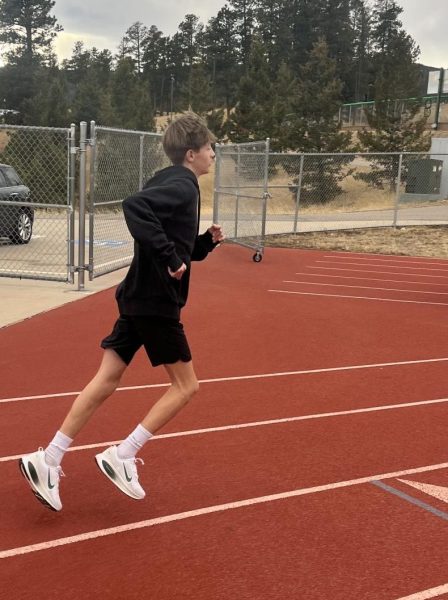
Along with the other events, there is also a 4×4 relay race where the athletes will run around the track once and then hand a baton to their teammate, who will then complete their own lap, continuing until all four athletes have completed their laps. This practice adds tension as runners can drop the baton or be inconsistent between laps, adding strategy to the race.
Athletes have practice every day after school from 4:00 to 6:00 p.m. with an on-off pair of days where they practice extra hard for one day and have a lighter workout the next.
“It makes you sore for the day, but I feel like it’ll help me in the long run,” freshman Keegan Finley said.
Behind the scenes of these daily workouts, coach Brian Stotts sees a lot of potential in the variety of students joining the program this year.
“We’ve got an interesting blend of kids who are really into track, and others who are just stepping through a door of opportunity that they might enjoy,” Stotts said.
The coaching staff is looking forward to the transition between practices and the real competitions.
“I’m excited to see what our first set of races shows about the talent that we have, and often, from a work ethic perspective, it’s that first race that really motivates an athlete to stay working hard in practice,” Stotts said.
Stotts also noticed that this specific group of kids seems particularly ready to work.
“I’ve heard a lot less complaining about tough workouts than I’ve heard in years past,” Stotts said.
With the season officially underway, the Lobos track team is balancing hard work with social time and high spirits. From the hard practices in the Conifer air to the excitement of regionals, the Lobos are ready for a successful season.


